Sunday, June 30, 2013

One-to-one

My school teaches students in a one-to-one classroom; one teacher, one student.  Doesn't this sound awesome?  From the teaching perspective, you can customize every lesson to the student and be sure they're really learning.  From the student perspective, you won't have to sit while the teacher's instruction outpaces your focus or interest.

We had an IEP meeting for one of our students and we were trying to convince the local school board that this student was making dramatic progress with us and thus his needs were being met.  The moderator said "who wouldn't make progress in a one-to-one classroom!"  And this got me thinking.  I wouldn't.  I would have HATED a one-to-one environment as a student.  I didn't like to be the object of too much intense teacher concentration (and really, we can be overly intense sometimes).  I liked to sit back and evaluate what the teacher said before deciding to accept or reject it.  I liked to have a little freedom and control over how I took my notes and whether or not my mind drifted during class.  I liked the opportunity to work with other students- our collective energy was so much more powerful than mine alone.

As a teacher, I'm not a huge fan of one-to-one either.  First of all, while "classroom management" is easier (this is a pretty silly word to use for one-to-one) it can also be more difficult because there's no escaping personality conflicts.  It's easier to get locked into battles of will (I avoid these like I would avoid Mexican food in NY- sorry guys, it's terrible)  but I've noticed these types of intense, pride posturing battles in classrooms near mine.  There are no other students near by to say "hey dude, chill out" and there's no one the teacher can turn to to exchange a sympathetic look with or to share a joke with to relieve the tension.  This leads to my biggest complaint against one-to-one.  It assumes that the teacher can teach all the student needs to learn.  THIS ISN'T TRUE!  Students learn so much more from each other.  The teacher can present content and establish a respectful and fun classroom culture, but the students sustain the culture, teach each other how to act, give each other support and encouragement, joke to relieve tension, boredom or frustration, and reinterpret the content in different ways so that their classmates can see it from multiple perspectives.  Learning is both a solitary and group endeavor.

So I know not many people have one-to-one classroom environments so this doesn't really matter to many besides me BUT I've been reading a little bit about the advent of personalized learning software.  It seems that since the whole constructivist approach to teaching math, where everyone had to learn everything in groups, hasn't really shown huge gains, there's a movement to go in the opposite direction.  Personalized learning software seems like it's going somewhere.  Knewton, a personalized learning software developer based in NY, and Pearson are teaming up to bring customized, competency-based learning to as many students as possible.  I think their vision of the future will be students sitting at home, in coffee shops, in libraries or even in classrooms, logging in to their program and getting a wholly customized learning experience.  The Knewton software amasses student data and has an algorithm that decides when a student is ready to move on to new material, and what that new material will be.  This is exactly like what I'm doing right now, except without the teacher.

Here's what I see happening:

  1. computers probably aren't smart enough to do this yet.  I don't know if they ever will be.  I have an Algebra student who asked me if numbers go on forever.  We had a nice side discussion on the nature of number and infinity which he understood.  His abstract reasoning capabilities have far outpaced his computational competence so he asks really good, deep math questions and understands the answers even when he struggles with adding fractions.  I can satisfy his deeper curiosity while still drilling him on basic arithmetic.  A program would decide that he's not ready for anything beyond basic computation. 
  2. I do believe that school is about more than learning content.  I think that learning to work cooperatively is important.  Learning to share a joke to relieve stress is important.  Learning how to speak up for yourself to an authority figure is important.  Socialization is important.  Maybe this just makes me old fashioned.  But having people by your side makes learning more fun too.  
  3. Peers push you to accomplish more than you can by yourself.  This is a problem I've seen in one-to-one teaching- that it's so much harder to motivate a student to study independently or to work on projects.  When there's no one to share it with, no peer audience, teenagers shut down and disengage.  Duh!  Even teenagers with special needs (we teach a lot of students with severe social anxiety) need peers to support them.  Even if you place kids in the same classrooms to use these educational technologies, they won't be learning the same content so won't be able to support or motivate each other effectively.  
  4. Finally, if you allow students to do the work at home, I think cheating will become the norm.  I think it already is.  A coworker of mine (a teacher!) admitted to me that she takes all of her sisters' online tests for her because her sister is an athlete and doesn't need school.  
Can't we find a middle ground?  There is never going to be one model that works for everyone, but we all deserve to experience different types of learning.  I may not like one-to-one learning because it makes me uncomfortable, but I went in to see my professors to get help on papers and it was good for me.  We all need a mix of different experiences.  We need technology and classrooms and individualized instruction and games and textbooks and teachers.  Why can't technology make our classrooms richer and more full of different kinds of learning?  Why is it a choice between classrooms or personalized learning?  Can't we recognized that there are good things about classrooms?  Why are we so obsessed with "or"?  Why not and?  Knewton and Pearson might say though that they are offering an "and" option.  That this is meant to enrich teachers' curricula not replace them, but I'm suspicious that this is just another way to devalue teachers' professionalism.  I read an article in Newsweek (I think but of course I can't find it now) where the head of one of these personalized software companies admitted that he didn't employ any educators on staff.  And Pearson, based on what I've seen of their textbooks, doesn't know that much about teaching either.  

Saturday, February 2, 2013

Logarithm Dominoes

I'm currently planning my pre-calc unit on logarithms and I just can't seem to find enough fun ways to drill logarithms.  It really is just about practice I think, but I HATE giving students worksheets full of problems.  I groan every time I see a Kuta software worksheet.  I know that games basically just do the same thing in a dressed up form, but at least there's a measure of competition or strategy that gives students a focus.  I just read Amy Gruen's post on practicing logarithms and almost threw out some expletives because I saw her link to logarithm dominoes and I spent a nice chunk of time last weekend to making my own logarithm dominoes.  Its both wonderful and incredibly frustrating to spend hours on something then find that someone got there first and did it better.  At least you know your idea was good, but you could have saved yourself so much time!  (this happened to me last year with Kate Nowak's logarithm laws worksheet .  I'd made one for myself then stumbled upon hers and hers was so much better!)  But fortunately for me, Amy Gruen's logarithm dominoes are very different from mine, so I thought I'd share what I came up with.

I threw together the following logarithm property dominoes.  I haven't had a chance to try them out yet, so I'm not sure the ratios are correct.  But I figured it was a start and I don't know when I'll have the initiative or time to post them again.  Here are the dominoes:

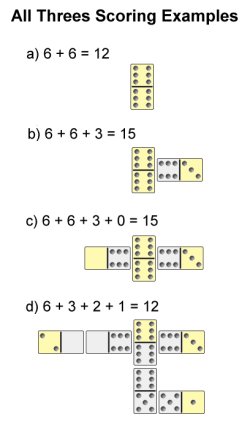
You should be able to play any domino game with these cards that you want but I planned to play the game "all threes".  Here are the rules:

  • Each player draws 5 dominoes.  You start by playing a double domino (one end equals the same number as the other end: 2-2 for example)
  • You can build off the double domino in 4 directions- above, down, left and right.  To play off a domino, you must match ends that have the same value.
  • Players take turns placing dominoes.
  • If a player can’t place a domino, they must draw more dominoes until they can play. 
  • After each player places a domino, count up the total of all loose ends.  If the total is a multiple of 3, the player gets that many points. 
  • The game ends when either a player runs out of dominoes in their hand or when a player reaches 100 points.  If a player runs out of dominoes in their hand, the player with the most points wins. 

Since these are logarithm expressions and not straight forward pips, players must make the conversions in their head or on paper.

Now I just need to figure out a fun way to teach solving logarithm and exponential equations.... 


Sunday, December 30, 2012

Sometimes Teaching is the BEST Job in the World

I received this message today from a student I taught for 3 years back in Oregon.

I wanted to thank you. Even though you are not my teacher anymore, you still help me all the time. You wrote in my yearbook to remember that I am good at math, and I always go back to that and it actually helps me when I am stressed about algebra. Whenever I think about it, I feel as though I can push through and actually do it. I am doing pretty well in it so far and I owe part of that to you.

Sometimes teaching is the best job in the world.

Wednesday, December 19, 2012

Common Core vs. Regents?

This being my first year teaching in New York, navigating the Regents has been a challenge.  I feel so torn in different directions that I've ended up in a state of complete and utter indecision.  Especially about geometry.  Here are the facts:

  • I'm teaching at a private school so technically, we don't have to do the Regents but our parents want us to offer Regents prep courses.
  • The private school has its own curriculum imported from its California model that isn't correlated either to New York State or to the Common Core.
  • We are restricted to 50 total sessions with the students per year rather than the 150 classroom hours you normally get at public school.  If we need to go over 50, the parents have to pay more so we try very hard not to do that.
  • I love all the ideas the blogging community has for geometry, but everyone seems to be pushing Common Core and the geometry Regents exam doesn't seem to be there yet.  
  • I have my own inclinations for teaching geometry that I'm having trouble shoving to the side to adhere to any standards.  
  • Two months ago my boss asked me to look at our boxed curriculum from California and compare it to the New York State Standards and the Regents exam and make sure they were aligned.  I discovered that they couldn't be more different and she has asked me to come up with a Regents friendly curriculum map.  
I LOVE the way Drawing on Math has organized her geometry class, but I'm really torn.  I was also very inclined to do parallel lines and transverals right at the beginning but a Regents aligned textbook, AMSCO-Geometry, puts it more than half-way through the course.  Why did they make this decision?  Is there some profound reason students should do congruent triangles and transformations first?  They've split up all the points of concurrency in triangles into different chapters too, whereas I was inclined to put them all together.  Which way is best?  A lot of the organization seems strange to me, but I've only learned geometry through teaching it over the past two years (I was skipped through it in High School and my college didn't offer any college level geometry courses) and I'm unsure whether or not to trust myself on what seems logical to me vs. how the book organizes material.

In the same Drawing on Math post, she also mentions scrapping most of the logic unit and only teaching converses.  But the NYS standards have LOTS of logic material including converses, negations, contrapositives, direct and indirect proofs, truth tables and Law of Detachment.  BUT, combing through old Regents exams reveals that they only ever seem to ask questions about negations, and the Common Core doesn't have much logic at all... Yet I love teaching it and when I got to college and took college level math courses, the fact that I'd been skipped through geometry became a real handicap in the more advanced proof based classes because I'd never been exposed to logic before.  So I'm inclined to teach logic because knowing just high school level geo-logic would have really helped me.  BUT we only have 50 sessions and I can't waste time on material not on the Regents exam.  BUT everyone's saying the Common Core is better anyway so shouldn't I align our curriculum to the Common core and not to a standardized test?  BUT our kids need to pass the Regents because our parents care about it so much.  

My heart tells me that I should just teach it in a way that feels right to me and if the kids really internalize the material they will pass the Regents.  Yet the Regents has such specific types of questions covering specific topics that I'm worried if I don't teach them with the Regents in mind, they'll get to the exam and it will use vocabulary they're not used to and ask types of questions we haven't covered.  I wish the State would just trust me a little.  I can help the students navigate this material but I want to let them enjoy it and I want to let them explore and I feel like I can't do that with this ticking bomb hanging over my head.  I guess I just have to try something and hope.  Teaching is about experimenting however nervous this makes me.  I hate the idea of an experiment failing at the detriment to a student's enjoyment of math.  But we learn by making mistakes right?

[12/20/12 edited to add the following paragraph] I'm still struggling with the geo curriculum and I decided to trust the book and do triangles before parallel lines and transverals but I'm running into difficulties.  If you don't do parallel lines and transversals first, then you can't do the proof that there are 180 degrees in a triangle (or at least you can't do my favorite one) and trying to do all the triangle stuff without this is pretty crippling.  In fact talking about angles at all becomes a little sticky.  We're supposed to do exterior angles in the triangle unit, but how do you prove any of the exterior angle theorems without knowing there are 180 degrees in a triangle?  And what about AAS triangle congruence?  They've thrown that in much later in the course 3 units after doing all the other triangle congruence theorems.  I wish textbooks provided a justification for how they organize their content because I always start by trying to follow a book (they know best right?  Tons of experts and trials in classrooms and thousands of dollars.) and then always scrap the book a quarter of the way in because their sequencing just doesn't make sense to me.  I wish I could squelch my internal sense of logic and just trust a textbook... my life would be so much easier.

Sunday, December 9, 2012

Where are the history teacher bloggers?

I have a confession to make.  I majored in history.  I loved doing research and piecing together an argument out of scraps.  I loved analyzing bias and wondering about how people's perceptions of history, true or false, shape how they act.  But teaching history was a whole different world.  The litany of timelines, facts, dates, and vocab words I was supposed to shove into students' heads while the clock was ticking left me with a sense of hopelessness.  I switched to teaching math.  In college I'd always taken a math class on the side because compared to studying history where nothing can be certain, the logical certainty of math kept my head from exploding.

My boss asked me recently, because of my history background, to help reshape the 8th grade history curriculum for our school.  We needed to take their curriculum that had been designed for California state standards and adapt it to fit into New York State standards.  Whenever I'm about to plan a lesson for math I consult my friendly math blogging community.  Sometimes I search specific blogs, sometimes I just google "system of equations activity" and scroll through the first few entries until I find one published by a blogger.  I've used curricula published by textbooks and by for-profit internet companies and visited the teacher stores and bought the workbooks.  None of the published material out there can even come close to matching the creativity of what math bloggers produce.  The lessons published by math teacher bloggers are adaptable, easy to implement, enjoyable and thought provoking.  I've been relying on this wonderful community for the last three years and I can't imagine teaching without it.  So when I needed to help develop curriculum for history, with joy I started googling to find fellow history teachers who could help me with this project.  Crickets.  Silence.  Page after page of historical info sites, or lessons published by for-profit companies.  Museum published curricula or government sponsored curricula abounded.  PBS has a wealth of nice lesson plans.  But where are the bloggers?  Maybe they're out there but they're much harder to find than their math teacher counterparts.  In fact, even while math teacher blogging is rich and prolific, none of the math teachers I've run across in real life know about this community and while I give them lists of my favorite blogs and tell them that it really is worth their time, none of them have followed up.

Reading math teacher blogs has revolutionized the way I think about teaching.  It has made me humble and insecure at times (because I feel like there's no way I'll be as awesome as the teachers I read about,) but that has pushed me to try more ideas, to keep pushing myself, to try to come up with lessons worthy enough to share.  When I feel overwhelmed or terrified by the responsibilities I've assumed the blogging community shows me others who push through difficulties with humor and humility and this gives me strength.  I guess I'm just trying to give a post Thanksgiving thanks.  My two month foray into history has made me so appreciative that there are math teachers out there taking care of each other.  I'm not a very good blogger yet, but I will keep striving to give back to this community that has given me so much.

Wednesday, November 21, 2012

The Math Teacher Anthem

We had a workshop yesterday where each teacher at our school showcased a lesson to all the students and the other teachers.  In the morning, the two music teachers had an awesome song writing workshop.  Our kids busted out the most heartfelt, funny, tuneful ballads.  The other math and science teacher, the history teacher and I got together in group to write a song which none of us had ever done before.  It turned into more of a poem and most of the clever bits were thought up by the history teacher, but I'm proud to say that the original idea and some of couplets were mine.  I think that this may need to be the official math teacher anthem:
Doesn't matter if its black or light
Fill my cup and you fill my life

Sandy knocked out gasoline
But please don't limit my caffeine

Cup of Joe
Sweet and low

Paper work stacking up
Please oh god just fill my cup

You can keep your weak green tea
I think that Dunkin' runs on me

Thoughts are sluggish, head aches
Pump me up till fingers shake

We only had about 10 minutes to write, so I don't think it's done yet.  We need a few more couplets (is that the proper literary term?  I'm not sure...)  Any suggestions?

Sunday, November 18, 2012

Equations of Vertical, Horizontal, Parallel and Perpendicular Lines

My new school is one-on-one instruction.  Just a teacher and a student.  In some ways this is AMAZING.  We can cover so much material, I can gear my explanations specifically to that student and take their learning styles into account, I can really see if they get it or if they're just faking it so as not to stand out.  It is not amazing in terms of games though.  None of my old games will really work.  A lot of them are team based, or competition based or communication/discussion based.  I can play some of the competition games with the student, but any of the games that are based on knowledge or practice are not too much fun because I'll always either beat the student or the student will know I'm going easy on them.  One of my boys got very upset with me when he realized I was "letting" him win.  I don't enjoy games where winning is based on chance (i.e. board games where you roll a die and answer the problem you land on.)  Or where math is just a hurdle to play the game, not the focus of it.

I've been writing a lesson plan on equations of horizontal, vertical, parallel and perpendicular lines and I came up with a game that I think will be good.  Winning takes strategy combined with luck and the strategy is independent of, yet still related to knowledge of the material.  This means that hopefully, the student will have a chance of beating me while still practicing equation writing skills.  I have NO idea if this game will work, but I thought I'd share it. Horizontal, Vertical, Parallel and Perpendicular Lines Game